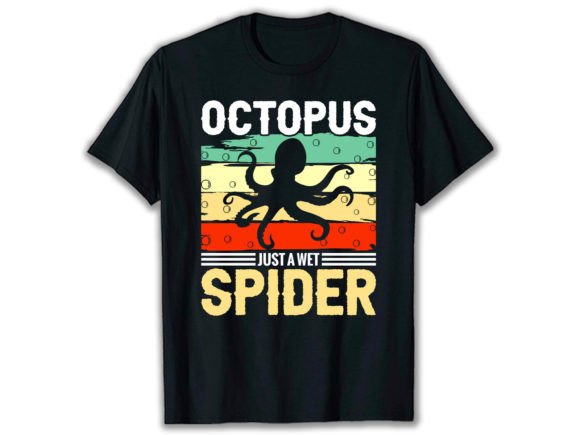
Octopus T Shirt Design, Vector
A Designer’s First Look: Playful, Clean, and Ready for Stitching
When I opened the Octopus T Shirt Design, Vector bundle, my first thought wasn’t “cute” — it was “workable.” As someone who’s digitized hundreds of machine embroidery designs and stitched them on everything from baby onesies to boutique aprons, I appreciate when a graphic template lands with clarity and purpose. This octopus has rounded limbs, friendly eyes, and just enough detail to read well at 3–4 inches wide — no overcomplicated tentacle curls or tiny facial features that vanish under satin stitch. It feels like a design made *for* embroidery, not just borrowed from a web graphic.
Where It Shines: Real Projects That Feel Thoughtful
Last week, I used the Octopus T Shirt Design, Vector as the centerpiece for a custom embroidered tote bag for a local marine-themed nursery shop. We stitched it on medium-weight canvas with tear-away stabilizer and a soft cotton thread blend. The result? Crisp outlines, smooth fill stitch coverage across the body, and limbs that held their shape without puckering. Customers loved how it looked both playful and polished — not too juvenile, not too clinical. That balance makes it ideal for:
- Sweatshirt embroidery (especially on crewnecks or hoodies with relaxed fabric tension)
- Embroidered patch production — clean edges mean easy cutting and clean backing
- Baby embroidery on onesies or burp cloths, where simplicity reads clearly at small scale
- Holiday embroidery on tea towels or kitchen linens — think “under-the-sea Christmas” or ocean-themed baby showers
- Personalized gifts for teachers, marine biologists, or aquarium volunteers
What to Watch For: Texture, Scale, and Fabric Behavior
This isn’t a one-size-fits-all embroidery file — and that’s okay. The Octopus T Shirt Design, Vector performs best when you match its visual weight to your fabric and hoop. On thin or stretchy fabrics like jersey tees, I’d recommend a light cutaway stabilizer underneath and slightly reduced stitch density in the fill areas to avoid stiffness. On textured surfaces — say, a woven linen apron or a looped terry towel — test stitch first: those smooth curves can soften or blur if the needle skips between fibers.
It also doesn’t love cramped spaces. If you’re planning to embroider it inside a 3" x 3" hoop on a curved cap front, reconsider scale or placement. The head and central body hold up fine, but the outer tentacles may compress or lose definition. Same goes for dark fabric: the design’s open negative space works beautifully on light backgrounds, but on navy or charcoal, make sure your thread colors have enough contrast — especially around the eye detail.
From Digital File to Handmade Product: What It Adds (and Doesn’t Add)
As a craft business owner and Etsy seller, I judge design assets by what they do for my finished product — not just how they look on screen. The Octopus T Shirt Design, Vector adds instant charm without sacrificing professionalism. When stitched cleanly, it signals care and intention. Customers notice that. A well-executed octopus on a linen pillow cover reads as boutique-quality; the same design poorly digitized or mis-scaled reads as rushed or generic.
It supports brand consistency too — whether you’re building a coastal-themed line or offering personalized baby embroidery, this design fits naturally into a cohesive visual story. But it won’t carry weak execution. If your thread tension is off or your stabilizer choice is wrong, the friendly vibe flattens into something floppy or uneven. So yes — it elevates handmade presentation, but only when paired with thoughtful technique.
Practical Notes Every Embroidery Designer Should Check
Before stitching your first client piece or listing an item on Etsy, run through these quick checks with the Octopus T Shirt Design, Vector:
- Test on scrap fabric first — especially if using it on baby items or garments meant for frequent washing.
- Review stitch density — high-density fills may need lighter stabilizer on delicate fabrics; low-density running stitch accents should be reinforced if used alone.
- Confirm hoop size compatibility — the vector format gives flexibility, but your embroidery machine’s maximum hoop area still applies.
- Inspect small details — the eye and suction-cup dots are subtle; verify they translate clearly at your intended size.
- Try black-and-white mockups — does it retain personality without color? That tells you how strong the shape language really is.
- Compare light vs. dark fabric backgrounds — some thread colors pop on white but disappear on black; adjust accordingly.
- Use proper stabilizer — medium-weight tear-away for stable wovens, light cutaway for knits, and fusible for layered or slippery fabrics.
- Verify licensing terms — since this is listed as a free Graphic Templates download, confirm whether commercial use (e.g., selling finished embroidered goods or digital embroidery files) is permitted before scaling your craft business.
Final Thought: A Reliable, Friendly Anchor in Your Design Assets
The Octopus T Shirt Design, Vector isn’t flashy — and that’s its strength. In a sea of overdesigned graphics, it offers clarity, adaptability, and quiet confidence. It works for a mom stitching her toddler’s first beach-themed birthday shirt, a small shop owner creating limited-run sweatshirts for a seaside festival, or an Etsy seller bundling embroidery files with printable mockups. It’s not trying to be everything — just a well-built, thoughtful piece of Graphics that earns its place in real embroidery projects.
If you're evaluating it for your next batch of custom apparel, tote bag designs, or holiday embroidery, trust your instincts — but back them up with a test stitch, a good stabilizer, and attention to how thread color interacts with your fabric. That’s where the real magic happens — not in the ZIP file, but in the finished product you hand over with pride.